Pre-built migration accelerators that simplify modernization, streamline data transitions, and speed up enterprise transformation across Microsoft platforms.
Every auction raises the same questions: which bidders will come back, how to win the next great consignment, and where marketing money works hardest. The answers sit in data from every part of the business.
About Barrett-Jackson
Barrett-Jackson is one of the world's leading collector car auction companies. Founded in 1971 and based in Scottsdale, Arizona, it holds live auctions in Scottsdale, Palm Beach, Columbus and Las Vegas.
Its auctions reach collectors, bidders and consignors around the world through live TV, streaming, sponsorships and charity events.
The data was in too many places to see the whole business.
Leaders needed one picture of auction, customer and financial performance. The data to build it sat across servers, services and three reporting tools.
01
Too many services to run
On-premises servers, Synapse, Data Factory, Blob Storage, VMs and dbt each had to be secured, maintained and paid for.
02
No single view of the business
Leadership could not see auction results, bidder and consignor activity, vehicle sales and finances together.
03
Three reporting tools
Reports were split across Tableau, SSRS and Power BI, so teams worked from different places.
The route
One service at a time, with nothing switched off before its replacement is ready.
We mapped every Azure service to its Fabric equivalent first, then planned the move in an order that keeps reports running throughout.
01 · Assess
Map every workload
We mapped each Synapse workload, pipeline and dependency to its Fabric equivalent, so nothing breaks when it moves.
02 · Organize
One lake, three layers
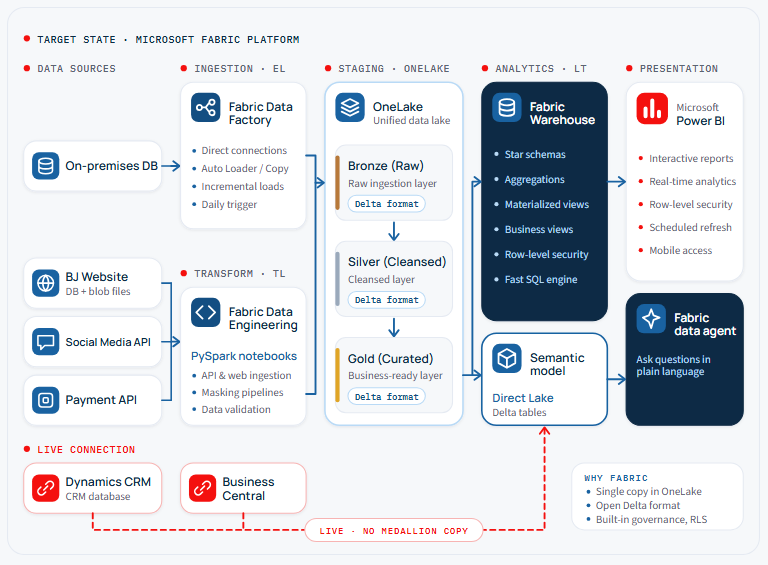
Raw, cleaned and business-ready data each get a layer in OneLake. Data Factory pipelines are rebuilt in Fabric Data Factory.
03 · Model
Model the data in Fabric
dbt models become PySpark notebooks, so the VM that ran dbt goes away. Fabric Warehouse replaces the Synapse dedicated pools.
04 · Ask
Reports and answers on Fabric
Tableau reports move to Power BI and read data through Direct Lake. A Fabric data agent answers questions on the same data.
Straight talk
The savings are estimates from the migration plan. Actual cost depends on capacity size and usage after go-live, and we will report what it turns out to be.
Sources flow through Fabric Data Factory into raw, cleaned and business-ready layers in OneLake, then on to Power BI and the data agent.
What replaces what
OneLake
Replaces Azure Blob Storage.
Fabric Data Factory
Replaces Azure Data Factory.
Fabric Warehouse
Replaces the Synapse dedicated pools.
PySpark in Fabric notebooks
Replaces Python and dbt on VMs.
Power BI on Direct Lake
Replaces the Tableau reports, Pro workspaces and scheduled refreshes.
Live auction dashboards
Sales, bidder activity and event results across auction locations, on desktop and mobile.
Technologies used
Data sources
Azure SQL
On-premises databases
Dynamics 365
Firebase Analytics
Microsoft Clarity
Sprout Social
Square API
Moving off
Azure Synapse Analytics
Azure Data Factory
Azure Blob Storage
dbt on a VM
Tableau
Microsoft Fabric
OneLake
Fabric Data Factory
Fabric Warehouse
Fabric notebooks
Semantic models
Power BI
Direct Lake
Fabric data agent
Official Microsoft product icons, used as issued and always beside the product name.
What changed
Less to run, less to pay, and answers as soon as the data lands.
One Fabric capacity replaces separately billed services. Each pipeline ends by refreshing the semantic model, so nobody reads yesterday's numbers by mistake. When a report doesn't answer the question, the data agent does.
One platform to secure, govern and monitor
One copy of the data in OneLake
One reporting tool, with the Tableau reports now in Power BI
No VMs to patch for Python or dbt
Reports refresh as soon as the pipeline finishes
What's next
The move runs one service at a time. Once Fabric is live, we will replace the estimates above with measured cost and usage.